
What Is E-Commerce Fulfillment?
An order comes in at 2:14 p.m. Your customer expects fast shipping, accurate items, clean packaging, and tracking that actually updates. If your team is still printing labels by hand or tripping over inventory in a back room, growth starts to feel expensive.
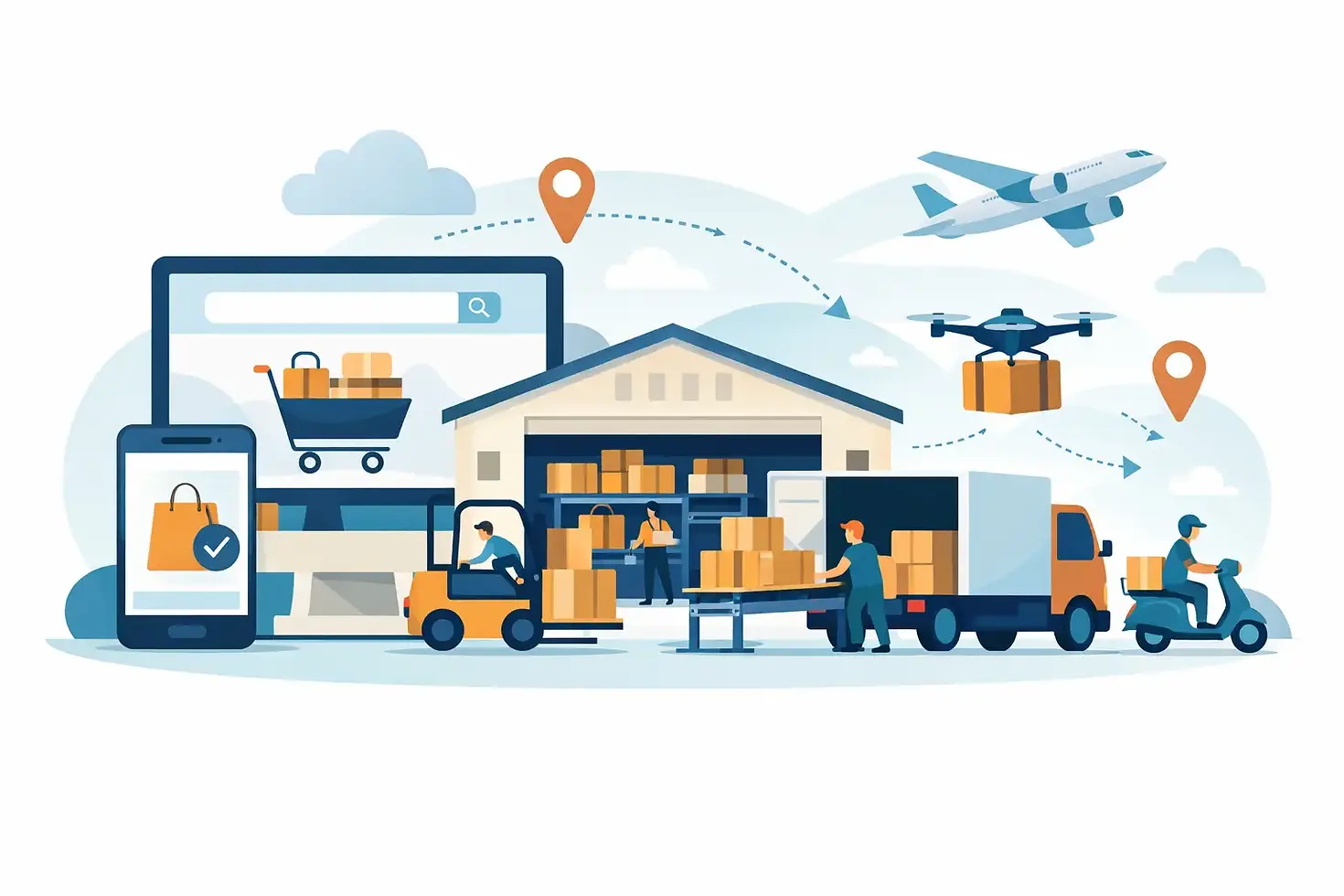
So, what is e-commerce fulfillment? It is the operational process behind getting online orders from stored inventory into your customer’s hands. That includes receiving products, storing them, tracking inventory, picking items when orders come in, packing them correctly, shipping them on time, and handling returns when needed.
For growing brands, fulfillment is not just a warehouse task. It affects delivery speed, order accuracy, customer satisfaction, labor costs, and how much time your team spends on operations instead of sales and growth.
What is e-commerce fulfillment and why does it matter?
E-commerce fulfillment is the system that turns a website sale into a delivered package. When it works well, customers get the right order on time and your business keeps moving without constant fire drills. When it breaks down, the problems show up quickly - delayed shipments, stockouts, wrong items, damaged products, and support tickets that eat up your day.
That is why fulfillment matters far beyond shipping. It touches the full customer experience after checkout. A strong marketing funnel can bring in new orders, but if your fulfillment process is slow or inconsistent, repeat purchase rates usually suffer.
For small and mid-sized brands, fulfillment also becomes a scale issue. What works at 20 orders a day often fails at 200. More orders require better inventory control, tighter processes, more warehouse space, stronger carrier coordination, and clearer visibility into performance.
How e-commerce fulfillment works
The process starts before a customer places an order. Inventory has to be received, counted, organized, and stored in a way that supports fast and accurate picking. If products are not logged correctly when they arrive, every step after that becomes harder.
Once inventory is in storage, your sales channels connect to a fulfillment system. That may include your online store, marketplaces, and other order sources. As orders come in, the system routes them for processing.
A warehouse team then picks the ordered items from storage locations, packs them based on the product requirements, applies the correct shipping label, and sends them out through the selected carrier service. Tracking data is pushed back to the store and the customer.
Returns are part of the picture too. A good fulfillment operation does not just ship outbound orders. It also receives returned items, inspects them, updates inventory counts, and follows the right restock or disposal process.
On paper, that sounds simple. In practice, each step requires controls. Barcode scanning, organized bin locations, quality checks, and real-time inventory updates make a big difference in whether fulfillment stays accurate as volume grows.
The core parts of an e-commerce fulfillment operation
Receiving inventory
Receiving is where your products enter the fulfillment workflow. Inventory arrives at the warehouse, gets inspected, counted, and entered into the system. Any mismatch between what was expected and what was received needs to be flagged early.
This step is easy to underestimate. If inventory is received incorrectly, your stock numbers are off from day one. That leads to overselling, missed orders, and avoidable customer service issues.
Storage and inventory management
Once received, products are stored in designated warehouse locations. Good storage is not just about space. It is about accessibility, security, and accurate inventory tracking.
Brands with seasonal products, bundles, fragile items, or products with expiration dates need more thoughtful inventory management. The right setup depends on what you sell and how fast it moves.
Picking and packing
Picking means selecting the correct items for each order. Packing means preparing those items for shipment in the right packaging, with the right inserts, protection, and labels.
This is where speed and precision have to work together. A fast operation that ships the wrong item is not efficient. A careful operation that takes too long can create delivery delays and labor inefficiency. Strong fulfillment teams build processes that support both.
Shipping and tracking
After packing, orders move to shipping. Carrier selection, service level, shipping zones, package dimensions, and cut-off times all affect cost and delivery performance.
Customers expect visibility, so tracking matters almost as much as transit time. If tracking is delayed or inaccurate, support requests tend to increase even if the order is technically on schedule.
Returns processing
Returns are part of e-commerce, especially in certain categories. A returns process should be clear, fast, and consistent. Returned units need to be inspected and routed correctly so inventory remains accurate.
For brands, returns are not just an operational cost. They are also a customer retention issue. A return handled well can preserve trust. A return handled poorly can lose a customer for good.
In-house fulfillment vs outsourced fulfillment
Many brands start by fulfilling orders in-house. That makes sense early on because it gives you control and keeps costs simple when volume is low. You can see your inventory, pack orders your way, and handle issues directly.
But there is a trade-off. As volume increases, in-house fulfillment often starts competing with the rest of the business for time, labor, and space. Founders get pulled into shipping problems. Staff spend hours on order processing instead of growth projects. Warehouse space runs short. Shipping costs become harder to manage.
Outsourced fulfillment, usually through a third-party logistics provider or 3PL, shifts those operational tasks to a specialized partner. The 3PL stores inventory, processes orders, manages packing and shipping, and often provides technology for inventory visibility and tracking.
This model is not automatically better for every business. It depends on order volume, product complexity, margin structure, and how much operational control you want to keep in-house. But for many growing brands, outsourcing creates room to scale without building a warehouse operation from scratch.
When outsourced e-commerce fulfillment makes sense
If your team is spending too much time on shipping, that is one sign. If order accuracy is slipping, inventory counts are unreliable, or you are running out of storage space, those are stronger signs.
Outsourcing can also make sense when your business has more complexity than your current setup can support. That might include subscription boxes, retail orders with routing requirements, Amazon prep needs, custom packaging, or seasonal volume swings that are hard to staff internally.
A good fulfillment partner should give you more than labor and warehouse space. You should expect operational consistency, real-time visibility, transparent pricing, and a service team that actually responds when questions come up.
That is where boutique support can matter. Some brands do not need a massive, one-size-fits-all provider. They need a fulfillment partner that can execute reliably while still adapting to the way their business runs.
What to look for in an e-commerce fulfillment partner
Technology is one part of the decision, but it is not the only part. A clean dashboard does not fix weak warehouse execution. You need both systems and process discipline.
Start with accuracy, speed, and visibility. Ask how inventory is tracked, how orders are verified, how same-day or next-day shipping is handled, and how performance is monitored. Then look at flexibility. Can the provider support custom kitting, branded packaging, retail prep, or Amazon requirements if your business needs them?
Pricing matters too, and clarity matters just as much. Fulfillment costs can include receiving, storage, pick and pack, packaging materials, postage, account management, and special project fees. If pricing is vague, surprises usually show up later.
Service should not be treated as a bonus. When inventory is delayed, an order has an exception, or a launch is approaching, responsive support matters. A reliable 3PL should feel like part of your operations team, not a black box.
Common misconceptions about e-commerce fulfillment
One common assumption is that fulfillment only means shipping boxes. It is wider than that. Inventory control, order management, returns, packaging standards, and system integration all shape fulfillment performance.
Another misconception is that the cheapest provider is the most cost-effective. Lower rates can look attractive until errors, delays, hidden fees, or poor communication start affecting your customer experience.
There is also the belief that switching to outsourced fulfillment means giving up control. In reality, the right partner can improve control by giving you better reporting, cleaner processes, and more reliable execution than an overstretched in-house setup.
For brands that want a hands-on logistics partner, Ship Zebra is built around that balance - disciplined fulfillment operations paired with attentive, white glove service.
What is e-commerce fulfillment really buying you?
At a practical level, it buys storage, labor, shipping execution, and technology. At a business level, it buys focus. Your team gets time back to work on product development, marketing, retail expansion, and customer growth instead of spending every afternoon chasing down orders.
It also creates a stronger foundation for scale. If your backend logistics can handle more volume without breaking, your business has more room to grow with confidence.
The best fulfillment setup is not always the biggest or the cheapest. It is the one that delivers orders accurately, on time, and with enough flexibility to support where your brand is headed next. Choose that well, and fulfillment stops being a daily stress point and starts acting like the growth engine it should be.


Comments